
Investment Casting & Shell Repair
Refractory Materials for Ceramic Shell Repair and Thermal Control
Investment casting shell defects require controlled assessment before repair because cracking, local spalling or damage around the pouring cup can affect mould strength, permeability, surface quality and containment of molten metal. The VITCAS range includes rapid-setting zircon repair compound, zircon refractory coatings, fire cement, white refractory mortar and high-temperature fibre blankets for defined repair, bonding, surface-protection and external-insulation duties. Products are not interchangeable: a coating is not a structural patch, and fibre insulation does not restore shell strength. Select the material according to the shell system, alloy, defect location, dewaxing and firing stage, pouring temperature and foundry-approved repair procedure. A repaired shell must be fully dried, inspected and formally accepted before preheating or pouring.
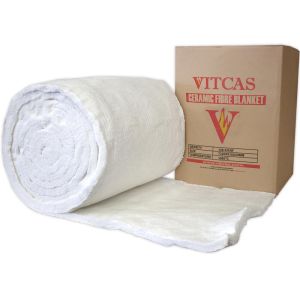 Manta de fibra cerámica aislante – Resistente hasta 1260 °C86,52 € 71,50 € Regular Price 125,84 € 104,00 €
La manta de fibra cerámica VITCAS es resistente a una temperatura máxima de servicio de 1260 °C, con una densidad de 128 kg/m³. Disponible en espesores de 13 mm, 25 mm y 50 mm, se utiliza ampliamente en industrias como la petroquímica, siderúrgica y cerámica. Ideal para aplicaciones de aislamiento térmico y revestimiento de hornos.
Saber más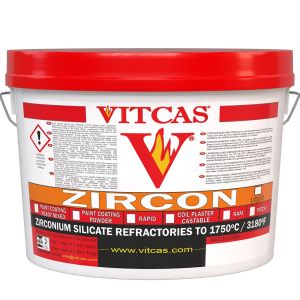 Revestimiento refractario de circonio VITCAS – Protección hasta 1750 °CPrecio especial 62,91 € 51,99 € Regular Price 110,10 € 90,99 €
Revestimiento refractario de circonio VITCAS. Tiene una consistencia cremosa y se puede aplicar directamente. Para aplicaciones por pulverización, debe diluirse con agua. Su temperatura máxima de servicio es de 1750 °C. Indicado para hornos, cucharas, revestimientos de fibra cerámica y materiales refractarios en contacto con aleaciones metálicas fundidas y vidrio.
Saber más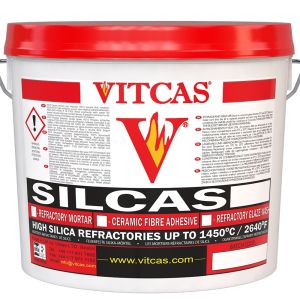 Silcas M – Mortero refractario blanco 1430°CTan bajo como 20,44 € 16,89 € Regular Price 31,45 € 25,99 €
VITCAS Silcas M – Mortero refractario premezclado de fraguado al aire para ladrillos ligeros y materiales aislantes hasta 1430°C. Es un mortero refractario de color blanco, ideal para aplicaciones donde se requiere un acabado visual y estético. Se utiliza para la colocación y el rejuntado de ladrillos y otros productos.
Saber más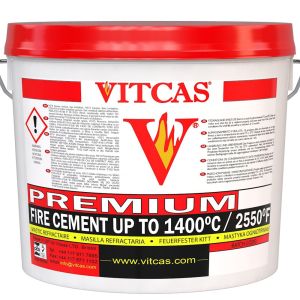 Masilla refractaria técnica resistente al calor hasta 1250 °CPrecio especial 47,18 € 38,99 € Regular Price 78,64 € 64,99 €
La masilla resistente al calor Vitcas Premium está diseñada para soportar temperaturas de hasta 1250 °C. Su consistencia tipo masilla facilita la aplicación y se endurece al exponerse a altas temperaturas. Apta para aplicaciones tanto domésticas como industriales, es ideal para crear uniones herméticas en tubos de humos y otros entornos de alta temperatura.
Saber más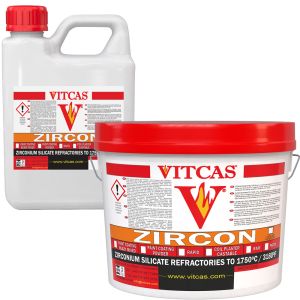 ZR – Compuesto refractario de circonio de fraguado rápido hasta 1750 °CPrecio especial 78,64 € 64,99 € Regular Price 125,83 € 103,99 €
Vitcas ZR es un compuesto refractario de alta calidad, a base de circonio, resistente a temperaturas de hasta 1750 °C. Al mezclarse, adquiere una textura semilíquida con consistencia plástica, lo que permite una aplicación segura y sencilla en la reparación de carcasas cerámicas de colada a la cera perdida o en la fijación de elementos calefactores en bloques cerámicos.
Saber más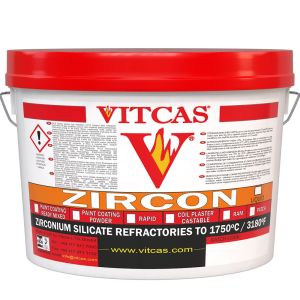 Revestimiento refractario de circonio VITCAS – en polvo, hasta 1750 °CPrecio especial 78,64 € 64,99 € Regular Price 110,11 € 91,00 €
El revestimiento refractario de circonio Vitcas se suministra en forma de polvo seco que se mezcla con agua. Este recubrimiento a base de circonio es resistente a temperaturas de hasta 1750 °C y es adecuado para diversas aplicaciones industriales, incluyendo su uso en la industria del aluminio y en revestimientos monolíticos de aluminosilicato.
Saber más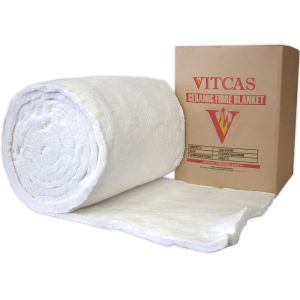 Manta de fibra cerámica aislante 1260 °C · por metro15,72 € 12,99 € Regular Price 25,16 € 20,79 €
La manta de fibra cerámica aislante VITCAS combina baja conductividad térmica y alta resistencia a la tracción, soportando hasta 1260 °C. Disponible por metro en espesores de 13 mm y 25 mm, con ancho de 610 mm y densidad de 128 kg/m³. Ideal para aislamiento térmico en hornos, calderas y procesos industriales de alta temperatura.
Saber más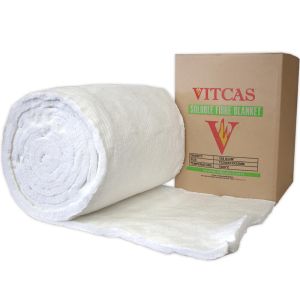 Manta aislante de fibra biosoluble – Resistente hasta 1200 °C94,38 € 78,00 € Regular Price 94,38 € 78,00 €
La manta aislante de fibra biosoluble Vitcas ofrece un rendimiento térmico excepcional, soportando temperaturas de hasta 1200 °C. Sus fibras de baja biopersistencia garantizan la seguridad durante el uso y la manipulación. Con una densidad de 128 kg/m³, proporciona un aislamiento fiable en aplicaciones de alta temperatura.
Saber más
Ceramic Shell Repair in the Investment Casting Process
In investment casting, repeated slurry and stucco coats form a ceramic shell around a wax or expendable pattern assembly. After drying, the pattern is removed, the shell is fired or preheated as required, and molten alloy is poured into the resulting cavity. The shell must retain its geometry, withstand handling and thermal shock, contain the metallostatic load and permit the gas transfer required by the validated process.
Damage can occur during shell building, drying, handling, dewaxing, firing, storage or transfer to the pouring area. Repair may be appropriate for a defined local defect when it is permitted by the foundry procedure and supported by process trials. It must not be used to conceal widespread weakness, delamination, contamination, dimensional movement or an uninvestigated recurring defect.
Match the Product to the Required Function
| Product | Temperature | Appropriate function | Important limitation |
|---|---|---|---|
| Zircon Rapid and Liquid | 1750°C | Rapid local repair of cracks, holes and defined damage in compatible investment casting shells | Five-minute set and 15-minute hardening are initial process times, not proof that the repair is dry, fired or approved for pouring |
| Ready-Mixed Zircon Refractory Coating | 1750°C | Thin protective coating on compatible refractory and aluminosilicate surfaces | Not a structural shell patch or an automatic substitute for the validated prime-coat slurry |
| Dry-Powder Zircon Refractory Coating | 1750°C | Water-mixed surface coating for compatible warm refractory substrates | Mix ratio, surface condition, coating thickness and drying must follow the current product instructions |
| Premium Fire Cement | 1250°C | General refractory sealing and repair where its heat-setting behaviour and chemistry are suitable | Do not assume suitability for the metal-facing surface or every investment shell and alloy combination |
| Silcas M White Refractory Mortar | 1430°C | Bonding compatible ceramic fibre insulation to the exterior of ceramic shells and jointing lightweight refractories | External bonding mortar; not presented as a replacement for shell slurry or a load-bearing shell repair |
| Biosoluble Fibre Blanket | 1200°C | Flexible external thermal insulation where the temperature grade and process allow | Does not restore shell integrity and can alter mould cooling and casting solidification |
| Ceramic Fibre Blanket | 1260°C | External insulation supplied in roll formats for engineered thermal control | Use according to the current safety data and keep loose fibre away from the mould cavity and molten-metal path |
The figures above are product limits rather than pouring-temperature recommendations. The repair material, shell and external insulation experience different temperatures during dewaxing, firing, preheating and casting. Confirm the current technical data, safety data and compatibility with the complete process before specification.
Assess the Defect Before Selecting a Repair
| Observed condition | Required assessment | Typical disposition principle |
|---|---|---|
| Fine surface indication with no evidence of penetration | Confirm depth, length, location, shell stage and whether it opens under light controlled inspection | Local repair may be considered only within written acceptance criteria |
| Local chip or spall on a non-cavity exterior | Measure the remaining sound section and inspect surrounding coats for delamination | Repair may be possible when the underlying shell remains sound and geometry can be restored |
| Through-wall crack, puncture or open hole | Evaluate molten-metal run-out risk, repair access, internal contamination and local load | Requires specific engineering approval; reject when sound restoration and verification cannot be demonstrated |
| Damage at the pouring cup, runner, transition, support or handling point | Consider metal head, handling load, turbulence and stress concentration | Treat as a higher-consequence defect requiring a defined repair design or rejection |
| Intentional vent or melt-out opening after pattern removal | Verify that the pattern material has been removed and the approved closure sequence is followed | Patch only with the specified material, geometry, drying and firing procedure |
| Widespread cracking, soft shell, bulging, delamination or poor intercoat bond | Investigate shell formulation, drying, handling and dewaxing rather than treating individual marks | Do not presume repairability; quarantine and apply the foundry rejection or concession procedure |
| Wet, contaminated or process-exposed shell | Identify water, oil, wax, cleaning agent, alloy or other contamination and its penetration depth | Do not coat over contamination; reject unless an approved recovery process demonstrates suitability |
Factors That Determine Whether a Repair Is Suitable
Shell Stage and Defect Origin
A defect found on a green shell around a pattern differs from one found after dewaxing or firing. Repairing without identifying the cause can allow the crack to reopen or migrate during the next thermal cycle. Record when the indication first appeared and examine likely contributors such as pattern movement, incomplete intercoat drying, shell geometry, handling, dewaxing rate and pressure release.
Repair Chemistry and the Casting Alloy
The repair must be compatible with the existing refractory and binder system as well as the alloy and atmosphere. Zircon-based materials may be selected for their high-temperature stability, but the name alone does not establish suitability for every steel, nickel alloy, aluminium alloy, titanium alloy, vacuum process or reactive-metal application. Consider chemical reaction, wetting, gas generation, inclusions and contamination limits.
Location Relative to the Casting Surface
Material applied to the exterior of a shell has a different effect from material that reaches the cavity face. An internal ridge, drip or displaced fragment can reproduce on the casting, restrict a thin section or become an inclusion. Prevent loose repair material, fibre and debris from entering the cavity, runner or pouring cup. Any cavity-facing repair requires a validated method and appropriate inspection.
Strength, Permeability and Thermal Expansion
A repair should remain bonded through subsequent drying, firing, preheating and pouring without creating a rigid stress concentration or weak interface. Excessive thickness can change local expansion, permeability and heat transfer. Temperature rating alone does not demonstrate green strength, fired strength, edge strength, thermal-shock performance or compatibility with the shell's expansion behaviour.
Thermal Control and Solidification
External fibre insulation can reduce local heat loss and extend the time for which a shell or selected section remains hot. This may support a deliberately engineered solidification strategy, but it can also change feeding, grain structure, shrinkage behaviour and cycle time. Determine insulation location, thickness, attachment and removal from casting trials or process simulation; do not wrap a shell simply because the blanket is temperature resistant.
Controlled Repair Workflow
The following sequence provides a specification framework. It does not replace the product instructions, foundry procedure or alloy-specific process qualification.
- Quarantine and identify: mark the shell or cluster, record the process stage and prevent it from advancing to preheat or pouring while the disposition is open.
- Inspect the complete shell: determine whether the indication is isolated or part of widespread cracking, delamination, deformation or poor shell build.
- Define acceptance authority: apply the drawing, customer, quality-system and foundry requirements for repair, concession or rejection.
- Select the repair system: match the repair compound, coating or external insulation to the shell chemistry, defect type, alloy, temperature and subsequent thermal cycle.
- Prepare the area: remove only loose material permitted by the procedure and keep dust, fibre and fragments out of the cavity. Do not enlarge a crack indiscriminately.
- Mix and apply consistently: follow the specified component ratio, working time, thickness and reinforcement detail. Do not add unapproved water or liquid to extend workability.
- Dry and thermally process: complete the approved drying, firing or preheat sequence. Initial set or surface hardness does not prove removal of moisture from the full repair section.
- Reinspect and release: check bond, coverage, geometry, cracks and cleanliness using the approved visual or non-destructive method. Record the repair and obtain release before pouring.
Using Zircon Rapid for Local Shell Repair
Zircon Rapid is a two-part zircon-based refractory system comprising powder and liquid. The current product information states a five-minute set and approximately 15-minute hardening time, so preparation and application should be organised before mixing. These values do not define the full working window under every ambient condition and do not replace the required drying, firing or preheating stage.
Use a consistent, procedure-defined repair geometry that bridges sound shell rather than merely masking the visible line. Avoid excessive build-up and abrupt edges that may concentrate stress. The repaired area should be traceable and reinspected after any subsequent thermal cycle that could reveal renewed cracking.
Using Zircon Coatings Correctly
Ready-mixed and dry-powder zircon refractory coatings provide thin surface treatment for compatible refractory substrates. They may seal or protect selected external surfaces, but a paint layer must not be assumed to restore a cracked shell's structural capacity. Neither product should be substituted for the foundry's validated primary slurry or backup shell system without trials covering adhesion, fired strength, permeability, surface quality and alloy compatibility.
Apply coatings only to the substrate condition specified in the current instructions. Surface cleanliness, porosity, temperature, dilution, thickness and drying all affect adhesion. Do not use a coating to hide a defect that still requires dimensional or structural assessment.
External Fibre Insulation and Bonding Mortar
High-temperature fibre blankets can provide external thermal insulation around selected shell regions or associated hot equipment. Silcas M is identified for bonding compatible ceramic fibre insulation to ceramic shells. The attachment must remain secure through handling and thermal cycling without blocking vents, contaminating the pouring path or interfering with shell support.
Choose between 1200°C biosoluble fibre and 1260°C ceramic fibre from the actual blanket exposure, not only the alloy pouring temperature. Review the current safety data for each product and control fibre and dust during cutting, fitting and removal. Do not describe a blanket as structural reinforcement unless a separately engineered and validated system provides that function.
Drying, Preheating and Molten-Metal Safety
Water and molten metal are a dangerous combination. Repair compounds, water-mixed coatings and damp shells must be dried and prepared under the approved process before pouring. A surface that feels hard or dry may retain moisture below the repair. The drying requirement depends on repair thickness, shell mass, ambient conditions, binder system and subsequent firing or preheat cycle.
Before pouring, verify that the mould quality is sufficient to prevent avoidable ejection or run-out of molten metal. Support the shell for the metal head and handling loads, use the required containment and screening, exclude non-essential personnel and wear correctly selected foundry PPE. A successful cosmetic repair does not reduce the need for these controls.
Quality Records and Process Validation
Record the shell or cluster identity, defect type and dimensions, location, discovery stage, repair batch, mix ratio, operator, application time, drying or firing cycle, inspection result and release authority. Link casting results back to the repair record so that flash, fins, inclusions, surface defects, dimensional changes and breakout incidents can be investigated.
For repeatable defects, address the process cause rather than relying on routine patching. Shell controls may include slurry solids, pH, viscosity, density, refractory content, drying conditions, coat sequence and shell strength or permeability tests. Establish repair limits through representative casting trials before incorporating them into production.
Frequently Asked Questions
What is investment casting shell repair?
It is a controlled process for restoring a defined local defect in a ceramic shell before casting. The repair must be compatible with the shell, alloy and thermal cycle, then dried, inspected and accepted under the foundry's quality procedure.
Can every cracked ceramic shell be repaired?
No. Repairability depends on crack depth, length, location, shell stage, surrounding bond, geometry and the consequence of molten-metal run-out. Widespread cracking, delamination, deformation or contamination may require rejection rather than patching.
Which VITCAS product is specifically intended for investment shell repair?
Zircon Rapid and Liquid is specifically described for rapid repair of cracks, holes and local damage in investment casting shells. Its suitability still requires confirmation against the particular shell system, alloy and approved process.
Is a shell ready to pour 15 minutes after applying Zircon Rapid?
Not automatically. Fifteen minutes is the published hardening time, not proof that all moisture has been removed or that the repair has passed firing, preheating and quality acceptance. Follow the complete approved process before pouring.
Is zircon refractory paint the same as investment casting face-coat slurry?
No. The listed zircon paints are refractory surface coatings. Do not substitute them for a validated investment casting prime slurry unless testing confirms the required adhesion, permeability, surface finish, fired strength and alloy compatibility.
Can zircon coating repair a structural crack?
A thin coating should not be assumed to restore structural capacity. Assess the crack and use a defined repair compound and geometry where repair is permitted. A coating may be part of a validated surface treatment but must not conceal unresolved damage.
Can Premium Fire Cement be used on any investment casting shell?
No. It is a general heat-setting refractory cement. Confirm its chemistry, temperature, bond, shrinkage and effect on the casting surface for the particular shell and alloy before use.
Can a shell be repaired before dewaxing?
Potentially, but the remaining pattern and the subsequent dewax cycle can load the shell and reopen the defect. The repair method must be approved for that process stage and should address the cause rather than only the visible crack.
Can a shell be repaired after dewaxing or firing?
A defined post-dewax or post-firing repair may be possible when cavity cleanliness, bond and the subsequent thermal cycle can be controlled. Through-wall defects and damage in highly loaded areas require specific engineering disposition.
Why must a repaired shell be fully dry before pouring?
Residual water can turn rapidly to steam when exposed to a hot mould or molten metal, creating pressure, spalling or violent metal ejection. Surface hardness does not confirm dryness through the repair thickness.
Does ceramic fibre blanket strengthen a cracked shell?
No. Blanket provides thermal insulation and should not be credited with structural restoration. Shell strength must come from the approved ceramic construction or repair system.
What is Silcas M used for in investment casting?
Silcas M is identified for bonding compatible ceramic fibre insulation to the exterior of ceramic shells. It is not presented as the primary shell slurry or a universal structural patch.
How does external insulation affect the casting?
It reduces local heat loss and can alter shell temperature, alloy solidification, feeding and cycle time. Location and thickness should therefore be established through process design, simulation or representative casting trials.
Can the same repair material be used for every alloy?
No. Consider chemical reaction, wetting, gas generation and inclusion limits for the specific alloy and atmosphere. Reactive alloys and tightly controlled aerospace or vacuum processes may require dedicated qualified shell systems.
How should a repaired shell be inspected?
Use the foundry's approved method to verify crack closure, bond, geometry, coverage, cleanliness and absence of renewed damage after thermal processing. Record the result and release authority before pouring.
Can a ceramic shell be reused after casting?
Investment casting shells are normally sacrificial and are broken away from the solidified casting. Shell repair refers to recovering an acceptable mould before its casting cycle, not reusing a shell after knockout.