
Structural Fire Protection
Cementitious Coatings and Boards for Structural Fire Protection
Structural fire protection limits temperature rise and helps loadbearing steel or concrete retain its required performance during a defined fire exposure. The VITCAS range includes FPC trowel-applied cementitious coating, FPC-S spray-applied cementitious coating and HT non-combustible fireboard. These products have different functions, installation methods and evidence requirements. Select the complete system from the project fire strategy, structural substrate, required period and classification, design fire exposure, section geometry, environmental conditions and approved test or assessment data. Reaction-to-fire class A1, a maximum material temperature or a general claim of up to 240 minutes does not by itself establish the fire resistance of a beam, column, floor, wall or other construction.
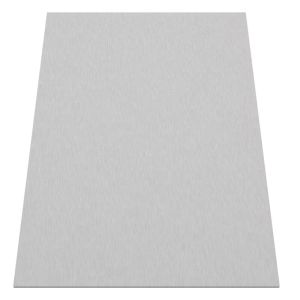 HT - Placas Resistentes a Altas TemperaturasPrecio especial 47,18 € 38,99 € Regular Price 62,91 € 51,99 €
Las placas resistentes a altas temperatura VITCAS son tableros ignífugos de altas temperaturas que no contienen yeso. Se pueden usar con Yeso Resistente a Altas temperaturas en las zonas donde no se puede aplicar el Enfoscado. No tienen calificación inflamable según EN 13501-1:2002. Son resistentes al agua y al fuego, al moho y hongos.
Saber más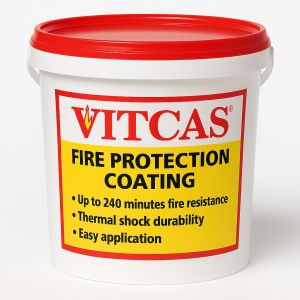 Vitcas FPC - Revestimiento ignífugo pasivo para acero y hormigónPrecio especial 78,64 € 64,99 € Regular Price 94,37 € 77,99 €
Vitcas FPC es un revestimiento ignífugo de mezcla seca, aplicado con llana, compuesto de vermiculita no combustible y cemento. Diseñado para la protección pasiva contra incendios en estructuras de acero y hormigón, proporciona hasta 240 minutos de resistencia frente a incendios de hidrocarburos y celulósicos. Este revestimiento resistente al fuego soporta el choque térmico, los impactos y la exposición al agua. Su aplicación es sencilla y no requiere equipos especializados, ofreciendo un acabado liso y duradero que puede repararse localmente cuando sea necesario.
Saber másSolicitar información sobre este producto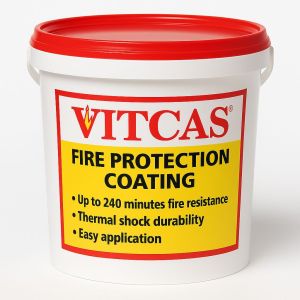 FPC-S – Revestimiento ignífugo proyectable de base cementosaPrecio especial 78,64 € 64,99 € Regular Price 94,37 € 77,99 €
Vitcas FPC-S es un revestimiento proyectable de alto rendimiento a base de cemento, diseñado para la protección pasiva contra incendios en estructuras de acero y hormigón. Ofrece hasta 240 minutos de resistencia al fuego frente a incendios de hidrocarburos y celulósicos, manteniéndose duradero frente a choques térmicos, sobrepresiones por explosión e impactos mecánicos. Adecuado para plantas petroquímicas, instalaciones de petróleo y gas, tanques de almacenamiento, recipientes a presión y estructuras de hormigón portantes, proporciona una protección contra incendios duradera tanto en interiores como en entornos expuestos.
Saber másSolicitar información sobre este producto
Structural Fire Protection Is a Tested System
Passive fire protection does not detect or extinguish a fire. Its purpose is to delay temperature rise and help a structural element maintain the performance required by the building or facility fire strategy. The outcome depends on the substrate, protective material, dry thickness, reinforcement or lath where required, primer, topcoat, geometry, fixings, joints, exposure and workmanship.
A product must therefore be specified within the field of application of its test, classification or technical assessment. A result for one steel section, concrete construction, fire curve or environmental condition cannot automatically be transferred to another. Project documentation should identify both the required performance and the evidence supporting the proposed construction.
Products and Their Intended Roles
| Product | Format | Appropriate specification role |
|---|---|---|
| FPC Fire Protection Coating | Cementitious dry mix applied by trowel | Applied passive protection to compatible steel or concrete where the project system and required thickness are supported by relevant evidence |
| FPC-S Cementitious Spray Coating | Cementitious dry mix for spray application | Mechanised protection of compatible steel or concrete, including selected industrial duties covered by the approved test and assessment scope |
| HT High Temperature Fireboard | 12mm non-gypsum rigid board | Non-combustible A1 board for compatible high-temperature linings and documented board constructions; not automatically a structural fire-protection encasement |
FPC Trowel-Applied Cementitious Coating
FPC is a vermiculite-and-cement dry mix applied manually to prepared steel or concrete. Trowel application can suit small areas, restricted access, local reinstatement and projects where spray equipment is impractical. The product page states a minimum application thickness of 8mm without reinforcement and 13mm with reinforcement. These are application minima, not universal thicknesses for a stated fire-resistance period.
The product page publishes performance of up to 240 minutes for cellulosic and hydrocarbon fires. Use that claim only with the applicable test report, assessment, classification and thickness table. Confirm the protected element, fire curve, limiting temperature or assessment criterion, exposure arrangement, reinforcement, substrate and environmental scope. The required project thickness may exceed the application minimum and must be taken from the approved design.
FPC is described for bare or suitably primed steel, uncoated or primed concrete and compatible existing VITCAS coatings. Verify primer and bond compatibility rather than relying on the generic term primed. Surface cleanliness, alkalinity, moisture, dew point, mechanical key and any bonding coat or lath can materially affect adhesion.
FPC-S Spray-Applied Cementitious Coating
FPC-S is intended for mechanised application over larger or more complex steel and concrete areas. Spraying can improve output and access around beams, columns, vessels and irregular details, but equipment selection, water addition, hose length, nozzle technique, build per pass and rebound control must follow the approved method statement.
The product page states up to 240 minutes against hydrocarbon pool fire and up to 120 minutes against jet fire, together with resistance to blast overpressure, weather and impact. These are safety-critical claims. Before specification, obtain the named test standards, laboratory reports, assessed field of application, tested substrate, specimen geometry, dry thickness, reinforcement, acceptance criteria and environmental durability evidence. Do not infer jet-fire performance from a cellulosic or pool-fire result.
FPC-S should not be described as a thin-film coating without comparative thickness and density data. Cementitious sprayed fire protection is normally controlled by installed dry thickness and density. Include access for inspection and repair, overspray containment, masking and curing in the work plan.
HT High Temperature Fireboard
HT Fireboard is a 1200 x 800 x 12mm non-gypsum board with a published maximum temperature of 650°C and reaction-to-fire class A1 to BS EN 13501-1. Class A1 addresses how the board contributes to fire growth; it does not give the fire resistance of a wall, ceiling, beam or column in minutes.
A board system can achieve fire resistance only where the complete construction has suitable evidence. That construction includes the number and orientation of layers, framing or supports, fixing type and spacing, joints, edge distances, penetrations, insulation, cavity, substrate and exposure direction. The board page gives general fixing and finishing instructions but does not publish a structural encasement thickness table or an R, E or I classification for the listed applications.
Use HT Fireboard for a structural fire-protection duty only where a current classification or assessment explicitly covers that assembly. For other passive protection needs, compare fire-resistant boards, fabrics and barriers. Services passing through a fire-resisting construction require separately evidenced firestopping and penetration seals.
Reaction to Fire and Fire Resistance
| Property | What it describes | What it does not establish |
|---|---|---|
| Reaction to fire | A product's contribution to fire development, including combustibility and other classified behaviours | The number of minutes for which a protected structural element carries load or separates spaces |
| Loadbearing capacity R | The period for which a loadbearing element retains the required mechanical resistance under the classified conditions | Integrity or insulation unless these functions are also assessed |
| Integrity E | The ability of a separating element to prevent passage of flames and hot gases under the classified conditions | Loadbearing capacity or limitation of heat transfer |
| Insulation I | The ability of a separating element to limit temperature rise on the unexposed face | Structural loadbearing capacity by itself |
The required combination and duration depend on the element and project. For example, a steel column may require loadbearing capacity R, while a loadbearing compartment wall can require R, E and I. Approved Document B for England links recommended performance to the element, building use and height and, in relevant cases, sprinkler provision. Other UK jurisdictions and industrial facilities use their applicable regulations, standards and fire strategies.
Specifying Protection for Structural Steel
Steel loses strength and stiffness as its temperature rises. Applied protection slows heat transfer, but the dry thickness cannot be selected from the required number of minutes alone. Provide the structural fire engineer and system supplier with:
- Required fire resistance: the project period, classification and design fire exposure.
- Steel member: section designation, dimensions, mass and whether the web contains openings.
- Section factor: the heated perimeter-to-cross-sectional-area relationship used by the approved assessment.
- Exposure: the number of sides exposed and whether the member is a beam, column, brace, hollow section or composite member.
- Design temperature: the limiting or critical steel temperature justified by load ratio and structural fire design.
- Substrate system: steel preparation, primer, corrosion protection, mesh or lath, topcoat and connection details.
Use thickness data only within its assessed ranges. Cellular beams, castellated sections, tension members, hollow sections, composite members and unusual connection zones may require different evidence from plain I- or H-sections. Protection must continue around bolts, end plates, haunches and other heat paths where required by the design.
Specifying Protection for Concrete
Concrete elements can require applied protection to limit heating, spalling, loss of reinforcement strength or loss of loadbearing capacity. Selection depends on concrete type and strength, moisture condition, member geometry, cover to reinforcement, restraint, load, exposure faces and the required structural function.
Obtain an assessment applicable to the actual slab, wall, beam or column. Evidence for applied protection to concrete should define adhesion, thickness, substrate preparation and any mesh or key. Dense, smooth, contaminated, damp or previously coated concrete may require specific preparation. Do not use a steel thickness table for concrete or assume that a coating adds a fixed equivalent thickness of concrete without supporting assessment data.
Cellulosic, Hydrocarbon and Jet-Fire Exposure
Different fire scenarios impose different heating rates, heat fluxes and mechanical conditions. A standard building or cellulosic fire exposure is not equivalent to a hydrocarbon pool fire. A jet fire can add intense directional heat, turbulence and erosive force. A duration stated for one exposure cannot be transferred to another.
Industrial specification should identify the credible scenario from the fire and explosion risk assessment. For petrochemical, offshore, tank, vessel or process-plant use, confirm whether the evidence covers the required pool-fire or jet-fire standard, specimen orientation, blast or impact demand, substrate, dry thickness, mesh and environmental conditioning. A generic fireproof claim is not a design basis.
Substrate, Primer and Reinforcement Compatibility
The protection system must remain attached before and during fire exposure. Confirm every interface in writing:
- Steel: preparation grade, profile, residual salts, primer type, dry-film thickness and overcoating window.
- Concrete: soundness, laitance removal, moisture, curing compounds, previous coatings and surface key.
- Reinforcement: mesh or lath material, aperture, fixing type, spacing, overlap, position within the coating and corrosion resistance.
- Bonding layers: approved primers, key coats or bonding agents and their application rates.
- Topcoats: compatibility, vapour behaviour, weathering, chemical exposure and maintenance interval.
Unverified substitution can invalidate test evidence. Excess primer thickness, an incompatible corrosion coating or poor mesh position can reduce bond even where both products are independently described as fire resistant.
Thickness, Density and Application Quality
Prepare an inspection and test plan before work starts. It should define reference documents, hold points, substrate acceptance, ambient conditions, mixing, batch control, wet application, curing, dry thickness, density where relevant, adhesion testing, repairs and final records.
- Measure conditions: record air and substrate temperature, relative humidity, dew point and ventilation.
- Control water: use the approved quantity and clean equipment; excess water can affect density, strength, shrinkage and curing.
- Build in passes: observe maximum thickness per coat, setting intervals and reinforcement requirements.
- Measure dry thickness: use a defined sampling grid and acceptance rules, including local minima and maxima.
- Verify continuity: inspect corners, webs, flanges, connections, soffits, edges and concealed faces.
- Record traceability: retain product batch, installer, date, area, thickness results, repairs and photographic evidence.
Average thickness alone can hide unsafe local deficiencies. Excess thickness can also be unacceptable if it increases dead load, cracks, debonds or falls outside the assessed range. Use the system documentation for tolerances and remedial procedures.
Interior, Exterior and Industrial Environments
Fire performance and environmental durability are separate requirements. An external or exposed system may face rain, freeze-thaw cycling, UV, wind, salt, vibration, washdown, process chemicals, impact and corrosion under fire protection. Confirm whether exposure is internal dry, internal humid, semi-exposed, fully weather-exposed, offshore or chemically aggressive.
Claims such as weatherproof, water resistant or thirty-year service life require defined conditioning, substrate, topcoat and maintenance evidence. Cementitious protection can conceal corrosion of steel; design inspections so moisture ingress, cracks and damaged topcoats are detected before loss of section or bond becomes critical.
Interfaces, Penetrations and Later Alterations
Structural protection must be continuous through relevant connections and interfaces. Coordinate it with composite decking, cladding supports, partitions, movement joints, firestopping, service penetrations, cavity barriers and suspended ceilings. A coating on a beam does not seal a service penetration or provide compartment integrity unless the complete detail is separately classified.
Later fixings, brackets, cable supports and service installations can cut or compress the protection. Require controlled permits for penetration or removal, use approved reinstatement details and update the fire-safety information after alterations. Do not cover damaged work before it has been inspected.
Inspection, Maintenance and Repair
- Inspect adhesion and continuity: identify hollowness, cracking, delamination, spalling, exposed steel and unprotected fixings.
- Check water paths: investigate leaks, failed topcoats, corrosion staining and persistent dampness.
- Assess impact damage: inspect traffic areas, plant rooms, loading zones and maintenance access routes.
- Compare with records: use the original system, thickness map, photographs and classification documents.
- Repair as a system: cut back to sound edges, prepare the substrate and reinstate primer, mesh and coating to the approved detail.
- Record changes: document location, area, cause, materials, thickness, curing and inspection acceptance.
Local repair is suitable only where the retained material remains sound and the original system can be identified. Widespread delamination, corrosion, water damage, unknown legacy coatings or missing evidence requires investigation by competent fire-protection and structural specialists.
Safe Installation and Refurbishment
Review current safety data sheets and complete task-specific COSHH assessments for cement, alkaline wet material, dust and any additives. Control dust during dry mixing and board cutting with suitable extraction and work methods. Protect skin and eyes from wet cementitious products and provide suitable respiratory protection where residual exposure requires it.
Survey legacy buildings before disturbing existing sprayed coatings or boards. Older structural fire protection can contain asbestos, and sprayed asbestos coatings are high-risk materials requiring licensed work. Do not drill, sample, scrape or remove an unidentified coating until the material has been assessed under the applicable asbestos-management procedure.
Frequently Asked Questions
What is structural fire protection?
It is passive protection designed to limit heating and help loadbearing elements retain the performance required by the fire strategy for a defined exposure. It can include applied coatings, board encasement, concrete or other tested systems.
What is the difference between FPC and FPC-S?
FPC is intended primarily for manual trowel application, while FPC-S is intended for mechanised spraying and selected severe industrial exposures. Choose from the applicable test evidence, substrate, area, access, fire scenario and installation method.
Does FPC provide 240 minutes of fire resistance at 8mm thickness?
Do not assume so. Eight millimetres is stated as a minimum application thickness without reinforcement. The thickness required for a particular element and period must come from the applicable test or assessment table.
Does FPC-S provide 120 minutes of jet-fire protection on every steel section?
No universal performance can be inferred. Confirm the jet-fire test standard, dry thickness, section, orientation, reinforcement, limiting temperature, conditioning and assessed field of application for the project.
Is an A1 board fire resistant for 60 or 120 minutes?
Not from A1 classification alone. A1 is a reaction-to-fire class. Resistance in minutes belongs to a tested or assessed complete construction, including board layers, framing, fixings, joints and substrate.
Can HT Fireboard protect structural steel?
Only if a current test, classification or assessment covers the exact encasement system and steel member. The product page does not provide a structural-steel thickness table, so do not design an encasement from its 12mm board thickness or 650°C rating alone.
What do R, E and I mean?
R denotes loadbearing capacity, E integrity against passage of fire and hot gases, and I limitation of heat transfer. The project determines which criteria and duration apply to each element.
How is fire-protection thickness selected for a steel beam or column?
Use the required period and fire exposure together with the member section factor, limiting steel temperature, section type, exposure sides and the approved system assessment. A competent designer should schedule the resulting thickness.
Can the same thickness be used on all steel sections?
No. Lighter sections with a high heated-perimeter-to-area ratio generally heat more quickly than heavier sections. Geometry, exposure and design temperature must be included in the approved calculation or thickness table.
Can a coating tested on steel be used on concrete?
Only when separate evidence covers concrete. Substrate behaviour, adhesion and assessment methods differ. The concrete element, preparation, protection thickness and required performance must be within the documented scope.
What is the difference between cellulosic and hydrocarbon fire protection?
The exposures use different heating conditions. Hydrocarbon fires can heat a protected item more rapidly and intensely than a standard building-fire exposure. Use evidence for the actual design scenario rather than transferring a time rating between curves.
What is jet-fire protection?
It addresses directional, high-intensity flame with significant turbulent and erosive effects. Jet-fire performance needs specific test evidence and cannot be inferred solely from hydrocarbon pool-fire or cellulosic-fire resistance.
Can any steel primer be used beneath cementitious fire protection?
No. Primer chemistry, thickness, surface condition and alkalinity resistance affect adhesion. Use only a substrate and primer combination within the system evidence or formally approved by the responsible supplier and designer.
When is mesh or lath required?
Requirements depend on product, thickness, geometry, vibration, substrate and test evidence. The design must specify material, fixing, overlap and position. Do not omit reinforcement simply because the coating adheres before fire exposure.
How is installed coating thickness checked?
Measure dry thickness to an agreed grid and assess local readings as well as averages against the system acceptance criteria. Record corners, connections and difficult-access areas, not only flat representative faces.
Can cementitious fire protection be used outdoors?
Only where the complete system is approved for the exposure. Confirm weathering, freeze-thaw, topcoat, corrosion protection, drainage, impact and maintenance requirements. A general weatherproof claim does not define every exterior environment.
Can damaged structural fire protection be patched?
Yes, where the original system is identifiable and surrounding material and substrate remain sound. Follow an approved repair detail and restore every layer, thickness and reinforcement requirement. Investigate corrosion or recurring damage first.
Does structural fire protection replace firestopping?
No. Structural protection limits heating of loadbearing elements. Firestopping maintains the required performance at penetrations and joints. Each system needs evidence for its own function and must be coordinated at interfaces.
Who should specify structural fire protection?
The fire strategy and structural fire design should be prepared and coordinated by competent professionals. The product supplier and specialist installer then select and apply a system within its test, classification and environmental scope.