
Refractory Mortars
Ready-Mixed Mortars for Fire Bricks and Refractory Linings
Refractory mortars are used to form thin, heat-resistant joints between compatible fire bricks and refractory components in furnaces, kilns, foundries and high-temperature process equipment. The VITCAS range comprises ready-mixed, air-setting grades for general fire-brick work, lightweight insulating bricks and specialised high-alumina linings. Product temperature ratings extend from 1400°C to 1860°C, while application methods include trowelling and, for selected grades, dipping, coating or spraying. Specify the mortar according to the refractory material, joint design, operating temperature, process conditions and the product’s drying and initial heat-up instructions.
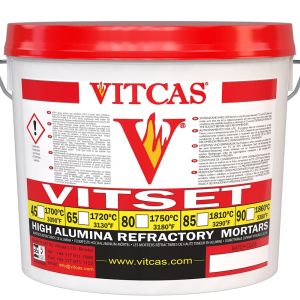 Vitset 45 Mortero refractario 1700°C – premezclado y de fraguado al aireTan bajo como 23,58 € 19,49 € Regular Price 47,18 € 38,99 €
Vitset 45 es un mortero refractario versátil, premezclado, diseñado para soportar temperaturas de hasta 1700°C. Es ideal para aplicar con llana, realizar reparaciones y colocar diversos tipos de ladrillos refractarios e aislantes de alta calidad con clasificación superior a 1400°C. También es apto para su uso con paneles y mantas de fibra cerámica, lo que lo convierte en una solución práctica tanto para reparaciones como para nuevas instalaciones en entornos de alta temperatura.
Saber más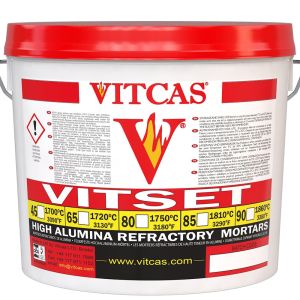 Vitset 80 Mortero refractario 1750°C – alta alúmina, premezcladoPrecio especial 86,52 € 71,50 € Regular Price 125,84 € 104,00 €
Mortero refractario Vitcas – Vitset 80 es un mortero de alta alúmina, premezclado y de fraguado al aire, que resiste temperaturas de hasta 1750°C. Es ideal para la colocación, inmersión, recubrimiento y pulverización de ladrillos refractarios. Adecuado para aplicaciones industriales como la producción de acero y las fundiciones.
Saber más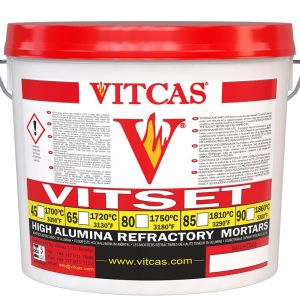 Vitset 85-Mortero Refractario PremezcladoPrecio especial 102,25 € 84,50 € Regular Price 141,57 € 117,00 €
Vitcas Mortero refractario- Vitset 85. Tiene un alto contenido en alúmina, cemento premezclado el cual está clasificado para temperaturas de 1810ºC / 3290oF.
Saber másSolicitar información sobre este producto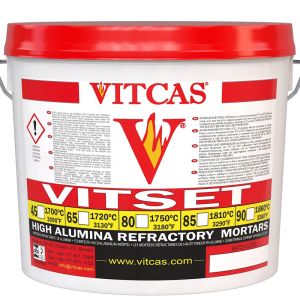 Vitset 90 Mortero refractario premezclado de alta alúmina 1860°CPrecio especial 110,10 € 90,99 € Regular Price 155,73 € 128,70 €
Vitset 90 es un mortero refractario premezclado de alta alúmina, reconocido por su excepcional resistencia térmica y estabilidad a temperaturas de hasta 1860°C. Ideal para aplicaciones industriales como la fijación de piezas prefabricadas y placas de compuerta deslizante, este mortero de fraguado al aire ofrece una solución práctica y fiable en entornos térmicos exigentes.
Saber más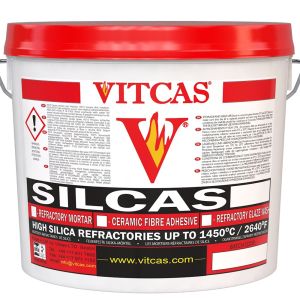 Silcas A – Mortero refractario 1400°CPrecio especial 47,18 € 38,99 € Regular Price 62,91 € 51,99 €
VITCAS Silcas A es un mortero refractario premezclado de fraguado al aire, con una resistencia a altas temperaturas de hasta 1400°C. Está diseñado específicamente para el rejuntado y la colocación de ladrillos refractarios, lo que lo hace ideal para aplicaciones de alta temperatura como hornos, estufas industriales y otros equipos de calefacción industrial.
Saber más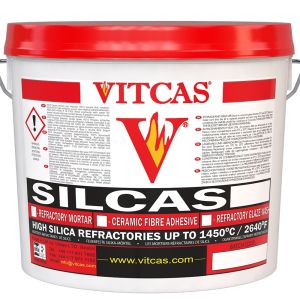 Silcas M – Mortero refractario blanco 1430°CTan bajo como 20,44 € 16,89 € Regular Price 31,45 € 25,99 €
VITCAS Silcas M – Mortero refractario premezclado de fraguado al aire para ladrillos ligeros y materiales aislantes hasta 1430°C. Es un mortero refractario de color blanco, ideal para aplicaciones donde se requiere un acabado visual y estético. Se utiliza para la colocación y el rejuntado de ladrillos y otros productos.
Saber más
Refractory Mortar for Thin-Joint Brickwork and Lining Installation
A refractory mortar bonds and beds compatible fire bricks, insulating bricks and selected refractory shapes while maintaining joint integrity at temperatures far beyond the capability of ordinary building mortar. It is designed for thin-joint refractory construction rather than general masonry. A mortar should therefore be selected as part of the complete lining system, not by temperature rating alone.
The products in this category are supplied ready mixed and set on exposure to air. They are distinct from dry, hydraulically setting refractory castables, which are mixed with water and placed in greater thicknesses to form or repair monolithic linings. They are also different from general-purpose fire cement and heatproof mortar intended for many domestic fireplace, stove and oven applications.
Which Refractory Mortar Should You Specify?
Match the mortar to the composition and density of the brick or refractory component, the designed joint thickness, the application method and the service environment. The maximum product rating must equal or exceed the calculated lining requirement, with an appropriate engineering margin. Where chemical attack, molten material, slag, abrasion or severe thermal cycling is expected, confirm suitability for the particular process rather than relying on temperature alone.
| Product | Temperature rating | Principal use | Selection note |
|---|---|---|---|
| Silcas A | 1400°C | Setting and jointing fire bricks and precast refractory shapes | Smooth, general-purpose grade for kiln and furnace walls, roofs, kiln-car work and maintenance |
| Silcas M | 1430°C | Lightweight insulating bricks and ceramic fibre insulation | Silica-based, off-white mortar suited to colour-matched joints, Grade 23 insulating bricks and selected investment-casting work |
| Vitset 45 | 1700°C | Dense and insulating refractory bricks, ceramic fibre products and local patching | Trowelling consistency; the product instructions state a maximum bed thickness of 3–5mm |
| Vitset 80 | 1750°C | High-alumina brickwork in steelworks, foundries, ladles and tundishes | High-alumina grade suitable for trowelling, dipping, coating or spraying; selected for demanding industrial lining work |
| Vitset 85 | 1810°C | High-temperature alloy processing and treatment vessels | Ready-mixed, high-alumina grade for specialised high-temperature installations |
| Vitset 90 | 1860°C | Precast shapes, sliding-gate plates and purging nozzles | High-purity, high-alumina grade for specialised steel, furnace and ladle applications |
The ratings above apply to the individual mortar grades. They do not raise the rating of a lower-temperature brick, insulation layer, anchor, coating or adjoining material. The permissible temperature of the complete assembly is governed by its design and by the least temperature-resistant critical component.
General Fire-Brick and Insulating-Brick Mortars
Silcas A is a smooth, ready-mixed mortar rated to 1400°C for setting and jointing fire bricks and compatible precast shapes. Typical work includes kiln and furnace sidewalls, arch-brick roofs, kiln-car bases and the installation of components such as peep-hole blocks and thermocouple tubes.
Silcas M is an off-white, silica-based mortar rated to 1430°C. It is intended particularly for lightweight insulating fire bricks, including colour-matched Grade 23 brickwork, and for compatible ceramic fibre insulation. Its colour and smooth consistency also make it relevant where the appearance of the joint or refractory surface matters.
High-Alumina Mortars for Industrial Linings
The Vitset grades address progressively more demanding temperature and process requirements. Vitset 45 is a versatile 1700°C mortar for trowelling, setting and local patching with dense refractory bricks, lightweight insulating bricks and selected ceramic fibre products. Vitset 80 is rated to 1750°C and can be applied by trowelling, dipping, coating or spraying; typical industrial duties include high-alumina safety linings in pouring ladles and components within continuous-casting tundishes.
Vitset 85, rated to 1810°C, is intended for specialised high-temperature work such as alloy processing and treatment vessels. Vitset 90 provides the highest temperature rating in this category at 1860°C and is designed for applications including sliding-gate plates, purging nozzles and precast refractory shapes. Before specifying any Vitset grade, confirm compatibility with the selected refractory fire brick or shape and with the operating atmosphere and process media.
Key Selection Criteria
- Refractory compatibility: match the mortar to the brick or shape type, including dense, insulating, aluminosilicate, high-alumina or other specialist refractories.
- Service temperature: use the product-specific rating and allow for temperature gradients, hot spots and the design margin required by the equipment or lining engineer.
- Process exposure: assess contact with flame, combustion gases, slag, molten material, chemicals, abrasion and repeated thermal cycling.
- Joint geometry: refractory mortar is normally used in thin beds. Observe the maximum thickness stated for the selected grade; do not use it to compensate for badly fitting bricks or large voids.
- Application method: confirm whether the work requires trowelling, dipping, coating or spraying and whether the selected grade is approved for that method.
- Drying and commissioning: allow the installed mortar to dry as instructed, then follow the specified gradual heat-up schedule for the lining and equipment.
- Installation environment: the grades shown are listed for indoor use. Protect uncured material and the completed lining from moisture unless the product and system specification expressly permits exposure.
Application and Commissioning
Ensure the refractory surfaces are sound, clean and dry, with dust, loose material, oil and grease removed. Stir the ready-mixed mortar where the product instructions require it, but do not add water or other materials unless expressly stated in the current technical data. Apply an even, fully contacted bed at the specified thickness and remove excess mortar before it hardens.
Do not bridge or fill designed movement and expansion joints unless the lining specification requires it. Large cavities, missing sections and deep repairs normally require a compatible castable or plastic mouldable refractory, not a thin-joint mortar.
Air setting does not mean that the installation can be heated immediately. Protect the work during initial drying and allow the stated curing period. Vitset 45 and Silcas A instructions specify 24 hours at room temperature before gradual firing, while other grades may have different requirements. Commission the complete lining in accordance with the equipment manufacturer’s procedure and the current product documentation.
Frequently Asked Questions
What is refractory mortar?
Refractory mortar is a heat-resistant jointing and bonding material formulated for compatible fire bricks, insulating bricks and refractory shapes. It forms thin joints in kilns, furnaces and other thermal equipment where ordinary masonry mortar would not withstand the service temperature.
Is refractory mortar the same as fire cement?
No. Although both withstand heat, refractory mortar is selected primarily for thin-joint refractory brickwork and lining installation. Fire cement is commonly used for smaller domestic appliance and fireplace repairs. Always choose the material whose stated substrate, joint size and service conditions match the application.
What is the difference between refractory mortar and refractory castable?
Mortar beds and bonds individual refractory units in thin joints. Refractory castable is a dry material mixed with a controlled quantity of water and placed, cast or rammed to form thicker monolithic sections. Mortar should not be used as a bulk substitute for castable.
Are these refractory mortars ready to use?
Yes. The mortars in this category are supplied ready mixed and are described as air-setting grades. Stir only as directed and keep the container sealed when the product is not in use.
Should water be added to ready-mixed refractory mortar?
Do not add water unless the current instructions for the exact product expressly permit it. Uncontrolled dilution can change the consistency, joint thickness, drying behaviour and finished performance.
How do I choose between Silcas A and Silcas M?
Silcas A is a general fire-brick and refractory-shape mortar rated to 1400°C. Silcas M is an off-white, silica-based grade rated to 1430°C and is particularly suited to lightweight insulating bricks, Grade 23 white brickwork and compatible ceramic fibre insulation.
Which mortar is suitable for high-alumina fire bricks?
The Vitset range contains high-alumina mortars for demanding industrial work, with individual ratings from 1700°C to 1860°C. Select the grade against the brick chemistry, process atmosphere, operating temperature and application method; the highest temperature rating is not automatically the best match.
How thick should a refractory mortar joint be?
Use the joint thickness stated for the selected mortar and lining design. These are thin-joint materials; for example, Vitset 45 instructions state a maximum bed thickness of 3–5mm. Do not assume that the same limit applies to every grade.
Can refractory mortar be used to repair large cracks or missing lining sections?
It may be suitable for compatible joints and limited local patching where the product instructions allow it. Deep cracks, large voids or missing monolithic lining normally require a specified castable, plastic mouldable or another engineered repair system after the cause of the damage has been assessed.
How long must refractory mortar dry before firing?
Drying time is product and installation specific. Vitset 45 and Silcas A state 24 hours at room temperature before gradual firing; other grades may differ. Low ambient temperature, high humidity, thick joints and low-porosity substrates can affect drying, so follow the current instructions for the mortar and the complete lining.
Does a 1860°C mortar make the whole lining suitable for 1860°C?
No. The system is limited by the fire brick, insulation, mortar, anchors, coatings, casing and other critical components, as well as the actual process conditions. Every component must be checked against the lining design.
Can refractory mortar be used in an expansion joint?
Not unless the lining design specifically calls for it. Expansion and movement joints are provided to accommodate thermal movement; filling them with rigid mortar can prevent them from functioning correctly.