
Glass Furnaces & Glassworking
Refractory Materials and Thermal Insulation for Glass Furnaces and Glassworking
Glass-melting furnaces, pot furnaces, glory holes, annealing kilns and glass-fusing equipment impose different thermal, chemical and mechanical demands on their linings. The VITCAS range includes zircon coatings and repair compounds, dense refractory castable, insulating fire bricks, refractory mortar, ceramic fibre and biosoluble fibre papers, blankets, boards and modules. Products support selected hot-face protection, local repair, element bedding, expansion allowance and thermal insulation in industrial and studio glass equipment. Specify each material for the actual glass composition, contact zone, furnace atmosphere, operating cycle, gas velocity, structural duty and risk of glass contamination. A published temperature rating alone does not establish suitability for contact with molten glass or for a complete glass-furnace lining.
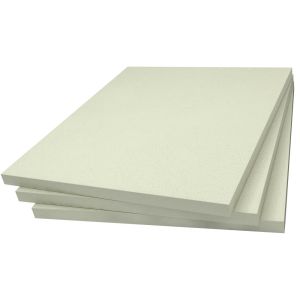 Panel aislante de fibra cerámica Vitcas – Resistente hasta 1260°CTan bajo como 86,52 € 71,50 € Regular Price 125,83 € 103,99 €
Panel aislante de fibra cerámica Vitcas. Resistente hasta 1260 °C. Dimensiones: 1200×1000×25 mm y 1200×1000×50 mm. Baja conductividad térmica a altas temperaturas y alta resistencia a la velocidad de gases, ideal para conductos de calderas, revestimiento de hornos en vidrio y cerámica, y sistemas de escape térmico.
Saber más Panel aislante de fibra cerámica Vitcas – Resistente hasta 1430°CTan bajo como 117,98 € 97,50 € Regular Price 151,00 € 124,79 €
El panel aislante de fibra cerámica VITCAS, resistente hasta 1430 °C, ofrece aislamiento térmico eficiente con ciclos de calentamiento y enfriamiento más rápidos. Dimensiones: 1200×1000×25 mm y 1200×1000×50 mm. Ideal para hornos cerámicos y procesos de curvado de vidrio.
Saber más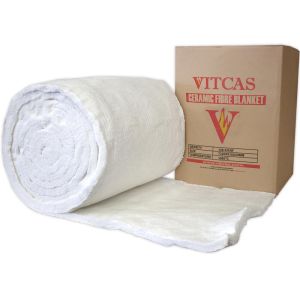 Manta de fibra cerámica aislante – Resistente hasta 1260 °C86,52 € 71,50 € Regular Price 125,84 € 104,00 €
La manta de fibra cerámica VITCAS es resistente a una temperatura máxima de servicio de 1260 °C, con una densidad de 128 kg/m³. Disponible en espesores de 13 mm, 25 mm y 50 mm, se utiliza ampliamente en industrias como la petroquímica, siderúrgica y cerámica. Ideal para aplicaciones de aislamiento térmico y revestimiento de hornos.
Saber más Manta de fibra cerámica aislante – Resistente hasta 1430 °C117,98 € 97,50 € Regular Price 171,46 € 141,70 €
Manta de fibra cerámica VITCAS. Resistente hasta 1430 °C. Densidad de 128 kg/m³. Disponible en espesores de 13 mm, 25 mm y 50 mm. Ideal como aislante térmico en hornos cerámicos para cocción de gres, porcelana y loza fina, así como en aislamiento para alivio de tensiones, protección contra incendios y generación de energía.
Saber más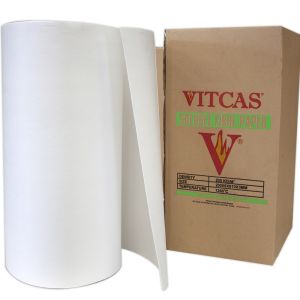 Papel de fibra cerámica aislante Bio 1200 °C · por metroTan bajo como 17,29 € 14,29 € Regular Price 20,44 € 16,89 €
El papel de fibra cerámica VITCAS, disponible en espesores de 1 mm, 2 mm, 3 mm y 5 mm con un ancho de 610 mm, ofrece resistencia térmica de hasta 1260 °C. Es ideal para aplicaciones de aislamiento térmico en entornos industriales de alta temperatura.
Saber más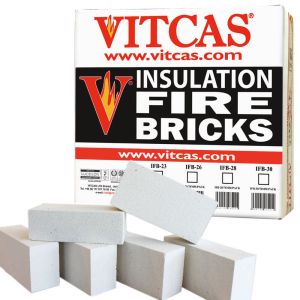 Ladrillos aislantes refractarios VITCAS Grado 26 -1430°CPrecio especial 4,39 € 3,63 € Regular Price 11,00 € 9,09 €
Ladrillos aislantes refractarios Vitcas – Grado 26. Resistentes a temperaturas de hasta 1430 °C. Dimensiones: 230 × 114 × 76 mm. Estos ladrillos refractarios aislantes son adecuados para una amplia variedad de aplicaciones industriales a alta temperatura, como en refractarios aislantes de productores de gas, hornos, cámaras de cocción y hornos de alivio de tensiones.
Saber más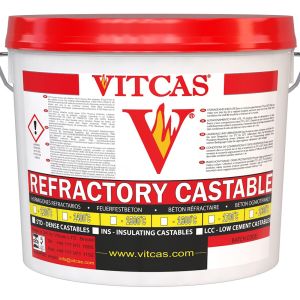 Hormigón refractario VITCAS 1600 °CPrecio especial 62,91 € 51,99 € Regular Price 70,77 € 58,49 €
El hormigón refractario (concreto refractario) se utiliza para la reparación de revestimientos de calderas, puertas de calderas e incineradoras. Está indicado para zonas donde las temperaturas localizadas son más elevadas, como en bloques de quemadores de gas o gasóleo, y en áreas donde se emplea aire forzado.
Saber más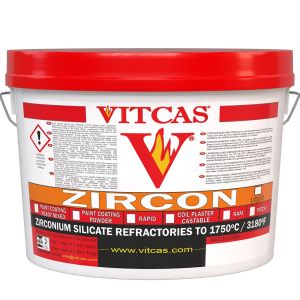 Revestimiento refractario de circonio VITCAS – Protección hasta 1750 °CPrecio especial 62,91 € 51,99 € Regular Price 110,10 € 90,99 €
Revestimiento refractario de circonio VITCAS. Tiene una consistencia cremosa y se puede aplicar directamente. Para aplicaciones por pulverización, debe diluirse con agua. Su temperatura máxima de servicio es de 1750 °C. Indicado para hornos, cucharas, revestimientos de fibra cerámica y materiales refractarios en contacto con aleaciones metálicas fundidas y vidrio.
Saber más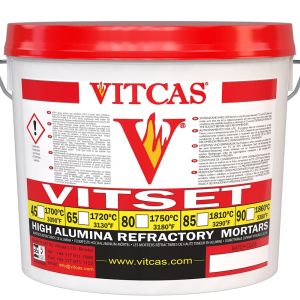 Vitset 45 Mortero refractario 1700°C – premezclado y de fraguado al aireTan bajo como 23,58 € 19,49 € Regular Price 47,18 € 38,99 €
Vitset 45 es un mortero refractario versátil, premezclado, diseñado para soportar temperaturas de hasta 1700°C. Es ideal para aplicar con llana, realizar reparaciones y colocar diversos tipos de ladrillos refractarios e aislantes de alta calidad con clasificación superior a 1400°C. También es apto para su uso con paneles y mantas de fibra cerámica, lo que lo convierte en una solución práctica tanto para reparaciones como para nuevas instalaciones en entornos de alta temperatura.
Saber más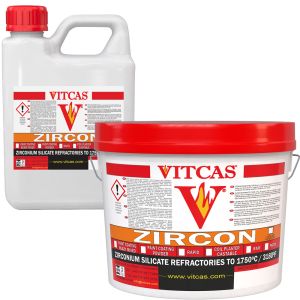 ZR – Compuesto refractario de circonio de fraguado rápido hasta 1750 °CPrecio especial 78,64 € 64,99 € Regular Price 125,83 € 103,99 €
Vitcas ZR es un compuesto refractario de alta calidad, a base de circonio, resistente a temperaturas de hasta 1750 °C. Al mezclarse, adquiere una textura semilíquida con consistencia plástica, lo que permite una aplicación segura y sencilla en la reparación de carcasas cerámicas de colada a la cera perdida o en la fijación de elementos calefactores en bloques cerámicos.
Saber más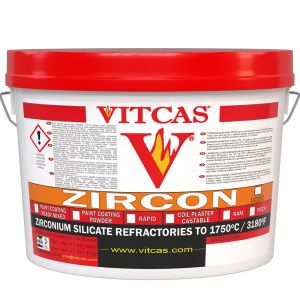 Zircon Patch - circonio para repararPrecio especial 149,44 € 123,50 € Regular Price 155,73 € 128,70 €
Circonio para reparar Vitcas tiene alta resistencia, es un material de reparación ligada químicamente el cual resiste altas temperaturas alcanzando 1750°C. Es una mezcla refractaria reparadora que puede usarse tanto en frio como en caliente repara debido a su alto contenido en humedad. El reparador a base de circonio se puede usar para reparar refractarios de sílice, circonio, alúmina.
Saber másSolicitar información sobre este producto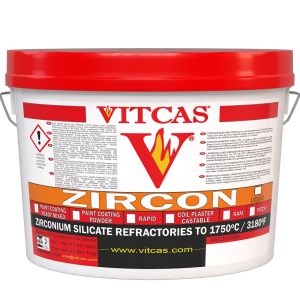 Zircon RamPrecio especial 149,44 € 123,50 € Regular Price 155,73 € 128,70 €
Vitcas Zircon Ram es una mezcla refractaria aplastada basada en circonio ligada químicamente. Tiene una consistencia simiesca con un contenido de humedad de 5%. Con la alta fuerza que tiene el Zircon Ram se puede utilizar en la industria del vidrio, especialmente para poner tanques de vidrio y hornos.
Saber másSolicitar información sobre este producto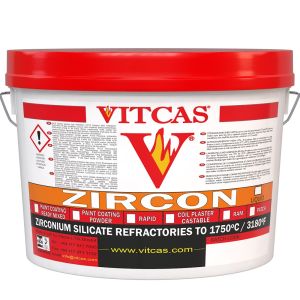 Hormigón refractario colable fino de circonio – 1750 °CPrecio especial 102,25 € 84,50 € Regular Price 108,54 € 89,70 €
VITCAS ZCP es un material refractario colable de grano fino a base de circonio, con excelente resistencia frente a metales y vidrio fundido. Con una temperatura de servicio de hasta 1750 °C, es ideal para aplicaciones de precisión donde los colables convencionales resultan demasiado gruesos. Al mezclarse con agua, adquiere una consistencia aplicable con llana, lo que lo hace adecuado para su uso en hornos de inducción, plantas petroquímicas, fábricas de vidrio y entornos de investigación a alta temperatura.
Saber más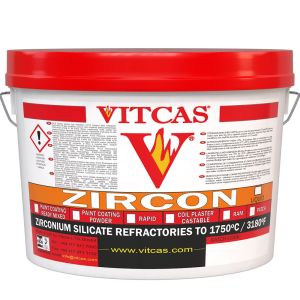 Revestimiento refractario de circonio VITCAS – en polvo, hasta 1750 °CPrecio especial 78,64 € 64,99 € Regular Price 110,11 € 91,00 €
El revestimiento refractario de circonio Vitcas se suministra en forma de polvo seco que se mezcla con agua. Este recubrimiento a base de circonio es resistente a temperaturas de hasta 1750 °C y es adecuado para diversas aplicaciones industriales, incluyendo su uso en la industria del aluminio y en revestimientos monolíticos de aluminosilicato.
Saber más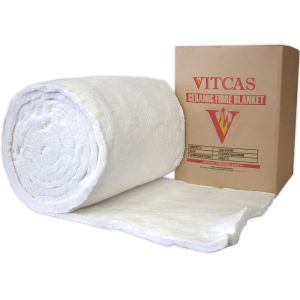 Manta de fibra cerámica aislante 1260 °C · por metro15,72 € 12,99 € Regular Price 25,16 € 20,79 €
La manta de fibra cerámica aislante VITCAS combina baja conductividad térmica y alta resistencia a la tracción, soportando hasta 1260 °C. Disponible por metro en espesores de 13 mm y 25 mm, con ancho de 610 mm y densidad de 128 kg/m³. Ideal para aislamiento térmico en hornos, calderas y procesos industriales de alta temperatura.
Saber más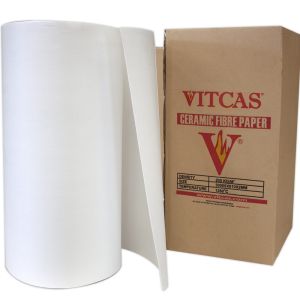 Papel de fibra cerámica – Aislante térmico hasta 1260 °CTan bajo como 188,60 € 155,87 € Regular Price 235,95 € 195,00 €
El papel de fibra cerámica VITCAS es un material de aislamiento térmico de alto rendimiento, disponible en espesores de 1 mm, 2 mm, 3 mm y 5 mm, con un ancho de 610 mm. Con una resistencia térmica de hasta 1260 °C, ofrece excelente durabilidad y protección frente al calor, ideal para aplicaciones industriales de alta temperatura como hornos, calderas y colada a la cera perdida.
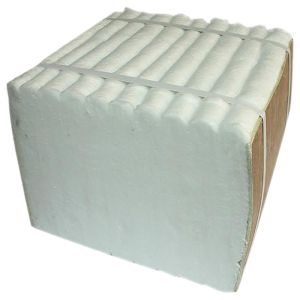 Módulos de Fibra Cerámica -1260°C
Los módulos de fibra cerámica son productos aislantes fabricados a partir de fibras cerámicas que se forman en módulos para su uso en aplicaciones de alta temperatura. Suelen utilizarse en hornos industriales y calderas, así como en instalaciones de generación de energía y procesamiento químico.
Saber másSolicitar información sobre este producto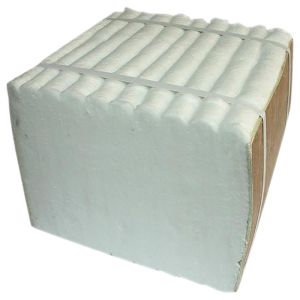 Módulos de Fibra Cerámica -1430°C
Los módulos de fibra cerámica suelen consistir en múltiples capas de material de manta de fibra cerámica que se apilan y comprimen en una forma rígida y modular. Las ventajas de los módulos de fibra cerámica incluyen su resistencia a altas temperaturas, baja conductividad térmica y excelente resistencia al choque térmico. También son ligeros y fáciles de instalar, lo que los convierte en una opción popular para muchas aplicaciones de alta temperatura. Los módulos de fibra cerámica son muy resistentes a las altas temperaturas.
Saber másSolicitar información sobre este producto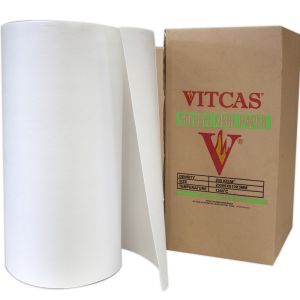 Papel aislante de fibra biosoluble 1200 °C155,73 € 128,70 € Regular Price 314,60 € 260,00 €
El papel aislante biosoluble VITCAS es un material de aislamiento térmico para altas temperaturas fabricado con fibras biosolubles avanzadas. Ofrece un rendimiento de aislamiento fiable en entornos térmicos exigentes. Con una temperatura máxima de servicio de hasta 1200 °C, este papel aislante ligero y flexible es adecuado para aplicaciones como hornos de cocción, hornos industriales, juntas térmicas y procesos de fundición a la cera perdida, donde se requiere una resistencia eficaz al calor y una buena durabilidad.
Saber más
Materials for Industrial and Studio Glass Equipment
Glassworking covers equipment ranging from small electrically heated fusing kilns to continuously fired melting furnaces. A studio furnace may use an insulated chamber, crucible or pot and reheating glory hole, while an industrial installation can include a melting tank, working end, forehearth, burner ports, crown, regenerators or recuperators and an annealing lehr. These systems cannot be specified from chamber temperature alone.
The lining normally combines chemically and mechanically appropriate hot-face materials with lower-density insulation. Contact with molten glass, batch carryover and condensates can be substantially more severe than exposure to hot combustion gases. The complete design must also control heat loss, shell temperature, expansion, gas flow, electrical clearances and contamination of the finished glass.
Functions Within a Glass Furnace Lining
| Material type | Primary function | Critical specification factors |
|---|---|---|
| Zircon refractory coating | Forms a thin protective surface on a compatible refractory substrate | Glass chemistry, substrate, coating thickness, preparation, adhesion, firing and contamination risk |
| Zircon patching, ramming or plaster material | Repairs or forms selected dense refractory details | Contact duty, repair depth, retained lining, compaction, bond, expansion and return-to-service procedure |
| Dense refractory castable | Forms burner blocks, shaped sections and selected monolithic repairs | Iron and impurity content, glass contact, anchors, mixing, curing, dry-out and thermal cycling |
| Insulating fire brick | Provides a rigid, low-density lining or backup insulation | Load, abrasion, glass or batch contact, temperature, jointing and thermal conductivity |
| Fibre paper, blanket, board or module | Provides low-mass insulation, separation or expansion allowance | Classification, shrinkage, fixings, gas velocity, abrasion, binder removal and fibre controls |
| Refractory mortar | Sets compatible refractory bricks in controlled joints | Brick chemistry, joint thickness, atmosphere, drying and exposure to molten glass |
Zircon Refractories for Surface Protection and Repair
Zirconium-silicate-based materials are used where a compatible refractory surface requires improved resistance to selected glass, alkali or molten-material exposures. The form of the product is important: a coating is not a structural lining, a patch is not a general casting mix and a ramming material requires adequate confinement and compaction. Confirm suitability for the specific glass formulation and furnace zone before use.
| Product | Temperature | Intended role within this application |
|---|---|---|
| VITCAS Zircon Paint Coating | 1750°C | Ready-mixed thin coating for compatible brick or aluminosilicate monolithic surfaces |
| Zircon Paint Coating Dry Powder | 1750°C | Water-mixed coating for prepared refractory surfaces, applied by brush or suitable spray equipment |
| Zircon Patch | 1750°C | Semi-dry chemically bonded material for selected repairs to compatible crowns and superstructures |
| Zircon Ram | 1750°C | Semi-dry ramming mix for compacted backing and repair duties, including behind approved glass-contact blocks |
| Zircon Coil Plaster | 1750°C | Fine-grained, water-mixed refractory plaster for precision lining details and compatible local repairs |
| Zircon Rapid | 1750°C | Rapid-setting two-part material for element bedding and small defined details rather than general furnace relining |
Explore the broader zircon refractory, refractory coating and refractory repair compound ranges when comparing product form and installation method. Claims such as non-wetting behaviour or resistance to molten glass must be verified for the actual glass chemistry, temperature, exposure time and substrate.
Dense and Insulating Refractory Construction Materials
| Product | Temperature | Typical role |
|---|---|---|
| Refractory Castable Grade 1600 | 1600°C | Dense low-iron castable for selected burner blocks, shaped sections and repairs where glass compatibility is established |
| Grade 26 Insulating Fire Bricks | 1430°C | Rigid low-density lining or backup insulation protected from unsuitable glass contact, impact and abrasion |
| Vitset 45 Refractory Mortar | 1700°C | Ready-mixed air-setting mortar for compatible dense or insulating refractory brickwork |
Dense castable and insulating fire brick perform different functions. Castable Grade 1600 can form mechanically robust monolithic details but requires controlled mixing, placement, curing and dry-out. Grade 26 brick has lower density and thermal conductivity but must not be assumed suitable for direct molten-glass contact or high mechanical wear. Mortar should be selected as part of the brick system and kept within the specified joint geometry.
Low-Mass Fibre Insulation and Separation Materials
Fibre products reduce heat storage and can accommodate shapes that are difficult to insulate with brick. Paper is thin and compressible, blanket is flexible, board is rigid and modules form a compressed lining system. These formats are not interchangeable, and none should be treated as load-bearing refractory masonry.
| Product | Temperature | Typical role |
|---|---|---|
| Biosoluble Fibre Paper per Metre | 1200°C | Thin flexible insulation, separation layer, gasket or expansion allowance |
| Biosoluble Fibre Paper | 1200°C | Sheet-form thermal barrier, separator or backing insulation in approved dry applications |
| Ceramic Fibre Paper | 1260°C | Thin aluminosilicate fibre insulation and separation material |
| Ceramic Fibre Blanket 1260 | 1260°C | Flexible chamber, backup and expansion-joint insulation protected from unsuitable wear |
| Ceramic Fibre Blanket 1430 | 1430°C | Higher-temperature flexible insulation in an engineered and adequately secured lining |
| Ceramic Fibre Board 1260 | 1260°C | Rigid insulation for controlled shapes, baffles and protected furnace or kiln areas |
| Ceramic Fibre Board 1430 | 1430°C | Higher-temperature rigid insulation where support, shrinkage and gas velocity are addressed |
| Ceramic Fibre Modules 1260 | 1260°C | Compressed modular insulation installed to a project-specific pattern and fixing design |
| Ceramic Fibre Modules 1430 | 1430°C | Higher-temperature modular insulation requiring verified anchors, compression and joint arrangement |
Calculate insulation thickness from the complete construction using thermal-conductivity data at the relevant mean temperatures. Include hot-face thickness, joints, anchors, element penetrations, shell, ambient conditions and the allowable external surface temperature. The maximum classification temperature of a fibre product does not predict furnace heat loss or cold-face temperature.
Selecting Materials by Glassworking Zone
Melting Tank, Pot or Crucible Zone
Refractories exposed to molten glass require the most stringent compatibility assessment. Corrosion can dissolve lining constituents into the melt, while erosion, joint washout or spalling can introduce solid defects. Specify against the exact soda-lime, borosilicate, lead, alkali-free, coloured, frit or other glass formulation, together with temperature, convection, residence time and acceptable contamination level.
The products on this page do not constitute a complete industrial glass-tank refractory package. Use a zircon coating, plaster or ramming material in a glass-contact zone only where current technical data, representative corrosion testing and the furnace designer approve the complete substrate and installation. Do not use fibre insulation, insulating fire brick or general mortar as an unverified substitute for specialist tank blocks or pots.
Crown and Superstructure
Crowns and superstructures are exposed primarily to flame, hot gases, batch carryover and volatile condensates rather than continuous liquid-glass contact. Temperature gradients, alkali vapour, silica or borate species, structural load and expansion all influence the choice of dense refractory and repair material. Zircon Patch is listed for selected crown and superstructure repairs, but the repair must remain compatible with the retained silica, alumina or zircon refractory and its movement.
Burner Ports, Glory Holes and Working Openings
Ports and openings experience high gas velocity, local flame impingement, repeated door movement and rapid thermal cycling. A dense castable or fine-grained zircon material may be appropriate for a defined block or repair, with insulation behind it. Preserve burner geometry, combustion air paths and clearances. Fibre blanket or board exposed directly to unsuitable flame velocity or mechanical contact can erode and release debris.
Annealing Kilns and Lehrs
Annealing equipment requires uniform and controllable cooling through the specified annealing range. Low-mass board, blanket, modules or insulating fire brick can reduce stored heat, but lining joints, door seals, element layout, air circulation and control-zone uniformity remain critical. An insulation upgrade can change heat-up, cooling and controller response, so the firing or annealing schedule may require recommissioning.
Fusing, Slumping and Enamelling Kilns
Studio and production kilns used for fusing, casting, slumping or enamelling need clean, stable interiors and controlled thermal gradients. Select paper, board or brick according to support, exposure and firing temperature. Where fibre paper is proposed as a shelf separator, verify that the specific product, glass and firing schedule are compatible and that loose fibre or binder residue cannot mark the work. Do not assume that every insulation paper is a reusable kiln-wash replacement.
Electric Elements and Penetrations
Element grooves, terminal penetrations and thermocouple openings require electrical clearance as well as thermal resistance. Zircon Rapid is presented for bedding heating elements into ceramic blocks, but the equipment manufacturer must approve the material, depth and effect on element temperature. Avoid rigidly locking elements where thermal expansion requires movement, and keep conductive contamination away from terminals.
Backup Insulation and Steel Casing
Blanket, board, modules and insulating fire brick can reduce casing temperature when protected by a suitable hot face. Design joints and penetrations to prevent direct heat paths. Fibre shrinkage, compressed joints, misplaced layers or failed anchors can create local hot spots even when the nominal insulation thickness is unchanged.
Glass Chemistry, Refractory Corrosion and Product Quality
Glass is not one chemical duty. Soda and other alkalis, boron compounds, lead oxides, colouring agents, fining agents, recycled cullet and contaminants can change refractory corrosion, wetting and volatilisation. The furnace atmosphere and redox condition can also affect both the melt and the lining. A material performing well with one glass composition may contaminate or corrode rapidly with another.
Refractory wear can contribute stones, cords, blisters, colour changes or other defects in finished glass. When quality is critical, compare chemical analysis, mineralogy, apparent porosity, bulk density, corrosion test results and impurity limits, including iron and other colouring species. Assess joints, coatings and repair binders as well as the main refractory body.
Temperature Ratings and Service Conditions
A product labelled 1200°C, 1260°C, 1430°C, 1600°C or 1750°C is not automatically suitable for continuous operation at that temperature. The published value must be interpreted with the current technical data, permanent linear change or shrinkage, load, atmosphere, exposure time and installation method. Hot-face temperatures can differ substantially from thermocouple readings, particularly near burners or electric elements.
For fibre systems, distinguish classification temperature from recommended continuous use temperature. For dense refractories, consider refractoriness under load, creep, corrosion and thermal cycling. For coatings and repairs, the substrate and bond can fail below the nominal temperature of the zircon aggregate.
Installation, Curing and Controlled Heat-Up
Record the original lining layers, dimensions, element positions, burner openings, expansion joints and control-sensor locations before demolition. Remove loose or contaminated material to a sound boundary and investigate corrosion, glass penetration or failed anchors before applying a local repair.
Prepare each substrate exactly as required. Coatings need a clean, compatible surface and controlled wet-film thickness; ramming mixes require confinement and compaction; castables require accurate water addition, placement and vibration; brickwork requires controlled joints. Mixing products, adding excess water or applying a thin coating over moving cracks can shorten service life.
Water-containing castables, mortars and repair materials require curing and a controlled dry-out or firing schedule. Heating too quickly can generate steam pressure and disruptive spalling. Fibre products may contain organic binders that evolve fumes during first heat-up, especially papers and boards. Provide ventilation and follow the current product and equipment instructions rather than treating a room-temperature set time as permission for full-temperature operation.
Inspection and Maintenance
- Inspect glass-contact areas: look for washout, pitting, drilling, open joints, glass penetration and changing melt colour or defect rates.
- Examine crowns and ports: identify spalling, displaced units, deposit attack, flame cutting and movement around expansion joints.
- Trend shell temperature: compare measurements under equivalent operating conditions and investigate new or expanding hot spots.
- Check coatings: record peeling, thinning, cracking, blistering and loss at joints or high-flow areas.
- Assess fibre linings: identify shrinkage gaps, erosion, loose fixings, damaged boards and exposed steelwork.
- Review elements and controls: inspect element support, terminal condition, thermocouple position and changes in heating balance.
- Record every repair: retain product batch, location, preparation, thickness, curing, heat-up and subsequent inspection data.
A local patch is appropriate only where the retained lining is sound and the cause of damage is understood. Repeated failure, deep glass penetration, widespread corrosion, structural movement or altered process quality may require engineered sectional replacement or a complete furnace rebuild.
Safe Work Around Glass Furnaces and Fibre Linings
Isolate fuel, electrical, pneumatic, hydraulic and mechanical energy before furnace maintenance. Allow adequate cooling and assess confined spaces, oxygen deficiency, residual glass, unstable refractory and stored thermal energy. Hot glass and apparently cold refractory can retain dangerous heat for prolonged periods.
Assess exposure to batch dust, respirable crystalline silica, refractory dust, fibres, binders and any lead, boron, arsenic, selenium, metal oxide or other hazardous constituent used in the process. Review current safety data sheets and apply the relevant COSHH or substance-specific controls. Use suitable extraction, controlled cutting and cleaning methods, and task-selected respiratory, eye and skin protection. Do not dry sweep fibre or silica-containing debris where a lower-dust method is practicable.
Frequently Asked Questions
Can the same refractory be used for glass furnaces and ceramic kilns?
Sometimes, but glass contact introduces a distinct corrosion and contamination duty. A product suitable for the hot gases in a ceramic kiln may dissolve into molten glass, create defects or lose joints in a glass furnace. Verify the glass composition and exact zone.
What is the best refractory for a glass furnace?
There is no universal best material. The tank, crown, ports, working end, forehearth and backup layers have different duties. Select the complete system for glass chemistry, temperature, corrosion, load, gas flow, expansion and acceptable product contamination.
Why are zircon refractories used in glassworking?
Zircon-based materials can provide useful resistance to selected molten-glass and alkali exposures. Performance still depends on zircon content, binder, porosity, substrate, temperature and glass composition, so the generic term does not establish suitability.
Can zircon paint be used directly against molten glass?
The product range includes coatings presented for molten-glass exposure, but approval should be based on current technical data and representative compatibility testing. A thin coating cannot compensate for an unsuitable, cracked or moving substrate.
What is the difference between Zircon Paint, Patch, Ram and Coil Plaster?
Paint is a thin surface coating. Patch is a semi-dry local repair material. Ram is installed and compacted as a ramming mix. Coil Plaster is a fine-grained, water-mixed refractory for precision details. Choose by geometry, thickness, support and installation method.
Is Zircon Rapid suitable for general glass-furnace repair?
It is a rapid-setting two-part product listed for investment-shell repair and element bedding. Use it in glass equipment only for a defined, manufacturer-approved detail; it should not be treated as a general tank, crown or large-area repair material.
Does a 1750°C rating mean the furnace can operate at 1750°C?
No. The rating is a material limit under stated conditions, not an operating approval. Glass corrosion, load, substrate movement, local heat flux and thermal cycling may control the safe service condition at a much lower temperature.
Can insulating fire brick contact molten glass?
Do not assume so. Its controlled porosity provides insulation but can also allow penetration and rapid attack. Use it as a glass-contact hot face only where the manufacturer and furnace designer provide specific compatibility data.
Can Refractory Castable Grade 1600 be used in a glass-melting tank?
Its temperature rating and low-iron description do not establish long-term tank compatibility. Obtain composition, porosity and corrosion data for the glass concerned. It may be more appropriate for selected burner blocks, shapes or non-contact repairs.
Can ceramic fibre blanket be left exposed inside a glory hole?
Only if the grade, fixing system, surface treatment and design are verified for flame impingement, gas velocity, temperature and mechanical contact. Otherwise use a suitable protective hot face or rigidised system.
Should I choose 1260°C or 1430°C fibre insulation?
Use calculated interface temperatures and the manufacturer's recommended continuous-use data, allowing for shrinkage, hot spots, atmosphere and ageing. Choosing the higher classification temperature alone does not resolve fixing or erosion limits.
What is fibre paper used for in a glass kiln?
It can provide thin thermal separation, a gasket, expansion allowance or approved shelf separator. Confirm whether the product is biosoluble or conventional ceramic fibre, its thickness, binder behaviour and whether it can contact the glass without marking it.
Can fibre insulation improve annealing-kiln efficiency?
It can reduce heat storage and transmission when correctly designed. It can also change heating and cooling response, so temperature uniformity, controller tuning and the established annealing schedule should be checked after a lining change.
Which mortar should be used with Grade 26 insulating fire bricks?
Vitset 45 is listed as a compatible high-temperature mortar, but confirm the specified joint thickness, exposure and glass-contact conditions. Mortar joints should not be used to correct poor brick fit or excessive movement.
Why is controlled dry-out necessary?
Castables, mortars and wet repair materials contain water. Rapid heating can turn it into pressurised steam within the lining, causing cracking or explosive spalling. Use a product- and thickness-specific curing and heat-up schedule.
Can a glass furnace be repaired while hot?
Only under a competent, engineered hot-repair procedure using a material approved for the temperature, access and zone. Product wording about hot repair does not replace isolation planning, heat protection, structural assessment and site safety controls.
How can refractory wear affect glass quality?
Dissolved refractory can change colour or chemistry, while fragments and reaction products can form stones, cords, blisters or inclusions. Track lining condition alongside defect location, frequency, glass composition and operating changes.
When should a glass furnace lining be rebuilt rather than patched?
Consider sectional or complete rebuilding when corrosion is widespread, glass penetration is deep, structural geometry has changed, crowns or anchors are unsafe, hot spots are increasing or repeated repairs no longer provide stable service or product quality.